Search This Blog

Wednesday, January 22, 2014

January Bill

Hi All...long time no blog, eh?  Yeah, the kiddos are keeping me busy and there's a bunch of things I'd like to blog about, but I just haven't gotten around to it.  Regardless, I'm back now with the latest energy results.  Shall we begin?

January 2013 Duke Energy Bill
Energy Consumed = 940 kWh
Billing Days = 31
Average Daily Consumption = 30.32 kWh/day
Heating Degree Days = 538
Energy per HDD = 1.75 kWh/HDD
Bill = $95.84

January 2014 Duke Energy Bill (Dec 1 - Jan 1)
Energy Consumed = 1,020 kWh
Solar Energy Back to the Grid = 33 kWh (99.4Next  kWh total generated)
Net Energy Usage = 987 kWh
Billing Days = 31
Average Daily Consumption = 31.84 kWh/day (5% increase in usage)
Heating Degree Days = 577
Energy per HDD = 1.71 kWh/HDD (2.3% reduction in usage)
Bill = $103.55 ($0.13 savings vs 2012 due to the higher rate)

Overall, I used about 5% more energy than 2013.  However, factoring in the colder weather, I was roughly the same with 2.3% reduction.  I'll take that.  I'm even OK with the 5% increase at face value.  Overall, I'd say sticking within 5% error is pretty darn good with the introduction of the twins to the family.  

Next month is ugly, as TED5000 is reporting that I'm averaging 44.7 kWh/day.  I'm sitting at 923 kWh used to date which extrapolates to ~1390 kWh/month.  Yikes!  Mind you much of that is due to the bitter cold we've been experiencing.  In 2013 we had 606 HDD.  We're CURRENTLY at 558 HDDs with 10 more days to go (including today).  And we're averaging 23 HDD/day (already removing the 4 coldest days).  That'll put this month at 788 HDDs!  That would explain the significant increase in usage (HVAC related).  And 1390/788 = 1.76 kWh/HDD which is generally on par with what I've been reporting.   

Thursday, January 2, 2014

Solar Panel Update - How close to expected?


Happy New Year everyone!  Well, now that the new year is upon us and I finally have a full month of data collection, I can look at how well my solar installation has performed compared to what was expected.  Be mindful that this really only 1 month of data.  The true test will be once we get a full year of data.  But I'm gonna show y'all anyway.


First let's get some of the background, shall we?  Below is a pic of what PV Watts estimated my house should get.  This is the same information that my Solar Contractor, Greenspring Energy, gave to me.

PV Watts Information

 The PVWatts information has a big ole' asterisk with it though.  This assumes full, unimpeded access to the sunlight.  Well, my house isn't in the middle of a field, so these numbers are not realistic.  That's where the SunEye report comes in as shown in the pictures below.
Monthly SolarEye Information


As you'll notice, due to shading, I should expect at most, 75% of the unimpeded values with February- October getting the best results (72-83%) and November-January getting significantly lower (47-66%).  December is the worst month with only 47%.

Wait...never seen one of these things?  Well, essentially what they do is take this fisheye camera thingy (yes, "thingy" is a technical term) and put it on multiple points on your roof where it takes a picture and overlays how the sun will track across it.  See the picture below:

SunEye Report for One of my Locations.
In my case they took 3 pictures at the 3 points of the triangle of my southern facing roof.  In the picture above (the peak of the triangle, best location) you can see how the tops of the trees (green) partially inhibit the sunshine from reaching my solar panels.  The evening trees (picture right) are in my backyard and is about a 50/50 mix of trees in my yard and my neighbors yard.  So if I wanted to increase my energy generation, I'd need to get myself a chainsaw.  However, I don't want to do that because those same trees shade my house and keep the temperature down.  I'll take that benefit instead.  If there was one thing I'd do would be to trim some of the those top trees that are significantly reducing Nov/Dec/Jan.  That could be really only 3-4 branches.  In one instance I know there's a tree that's dead on the top (shown in the pic above, the green splotch where the 10am line and Nov line meet) that probably needs to be trimmed or come down soon anyway.

OK...enough of that tangent...so getting back to the discussion, now let's look at my generation (from the Tigo website):

Tigo Energy Recordings
Overall I've produced just shy of 100 kWh/month for November and December.  And don't forget that I'm missing about 6-10 days of data as the system was energized on November 7th and wasn't fully operational until November 11th.  So let's take this data and compare it what was expected:

Comparison of Expected vs Actual Solar Power Generation
As we see for December, I was just over what was expected for the month which is good! If we were to extrapolate November we'd be a little under (say 130 kWh vs 145 kWh), but it's at least in the neighborhood. I'd say "so far so good".  I think what's going to be most interesting is when we get into this Spring.

I'll try to remember to post this similar information for each month in addition to my Duke Energy information.  If I can, I'll try to combine the two when I can.

Any thoughts out there?

Thursday, December 19, 2013

December Bill, No November?, Overall: Still doing OK

Happy Holidays!  Merry Christmas!  Happy Hanukkah!  
(Insert any other holiday you wish to celebrate)

My daughter wonders what Santa is going to bring her for Christmas...

If you've been keeping track, you may be saying..."uhh December?  What happened to November?"  Well...for some reason Duke Energy did not send me a bill.  And I cannot find my November information online except for what Duke wants to bill me.  It's as if November never existed.  Unfortunately, Duke Energy would not take the actual dollar value of the bill and make that disappear too.  In any event in the lack of actual data, I'll post what my TED5000 unit says I did.  So...without further ado...below my November and December usage data.

November 2012  (Oct 2 - Nov 1)
Energy Consumed = 509 kWh
Billing Days = 30
Average Daily Usage = 16.97 kWh/day  (Ranks as #5 best month ever) 
Heating/Cooling Degree Days = 217
Weather Normalized Usage = 2.35 kWh/HD
Bill =$58.14

November 2013  (Oct 2 - Nov 2)  <--TED5000 setup to always be 2nd to 2nd
Energy Consumed = 651 kWh
Billing Days = 31
Average Daily Usage = 21.0 kWh/day  (24% increase in usage)
Heating/Cooling Degree Days = 191 (minus 15 days where there were <5 CDD/HDD)
Weather Normalized Usage = 1.76 kWh/HD
Bill =$64.02 (from Duke Energy.  TED Estimate = $78.19).

Based on the Bill amount, I'm guessing TED was WAY off.  At $0.11/kWh, my usage should be in the neighborhood of 560 kWh comparing to 2012.  That's a 20% error.  If you compare October's Bill, TED says I used 746 kWh while my Bill said I used 595 kWh which adjusts up to 664 kWh adjusting for the bill having 28 days and TED having 31 days.  So TED is about 15-20% off on those two months.

December 2012  (Nov 1- Dec 3)
Energy Consumed = 970 kWh
Billing Days = 32
Average Daily Usage = 30.31 kWh/day
Heating/Cooling Degree Days = 533
Weather Normalized Usage = 1.82 kWh/HD
Bill =$98.52

December 2013  (Oct 28 - Dec 1)  <-- Back to Duke Energy Billing Cycle 
Energy Consumed = 951 kWh
Energy Produced = 45 kWh  <--Panels energized midday 11/4, but not producing fully until midday 11/11.
Net Energy Consumed = 906 kWh
Billing Days = 34
Average Daily Usage = 26.65 kWh/day  (12.1% reduction from 2012)
Heating/Cooling Degree Days = 530
Weather Normalized Usage = 1.71 kWh/HD
Bill =$96.66

The good news here is that without factoring in the solar panels, I used less energy in 2013 than I did in 2012.  And that's with roughly the same Heating Degree Days.   Including the energy I generated, easily puts me at well below my 2012 usage by ~12%.   So far this month, according to TED, I'm on a similar pace to be just right around my 2012 consumption without the solar panels.  Apparently, the weather has been similar to last year also.  Through yesterday, the preliminary weather data is showing we've used 310 HDDs or 17.22 HD/day.  Extrapolating to 32 days, we're on pace for 551 HDDs compared to 533 in 2012.    

Monday, November 11, 2013

Tigo Energy Maximizer


Tigo Energy Maximizer

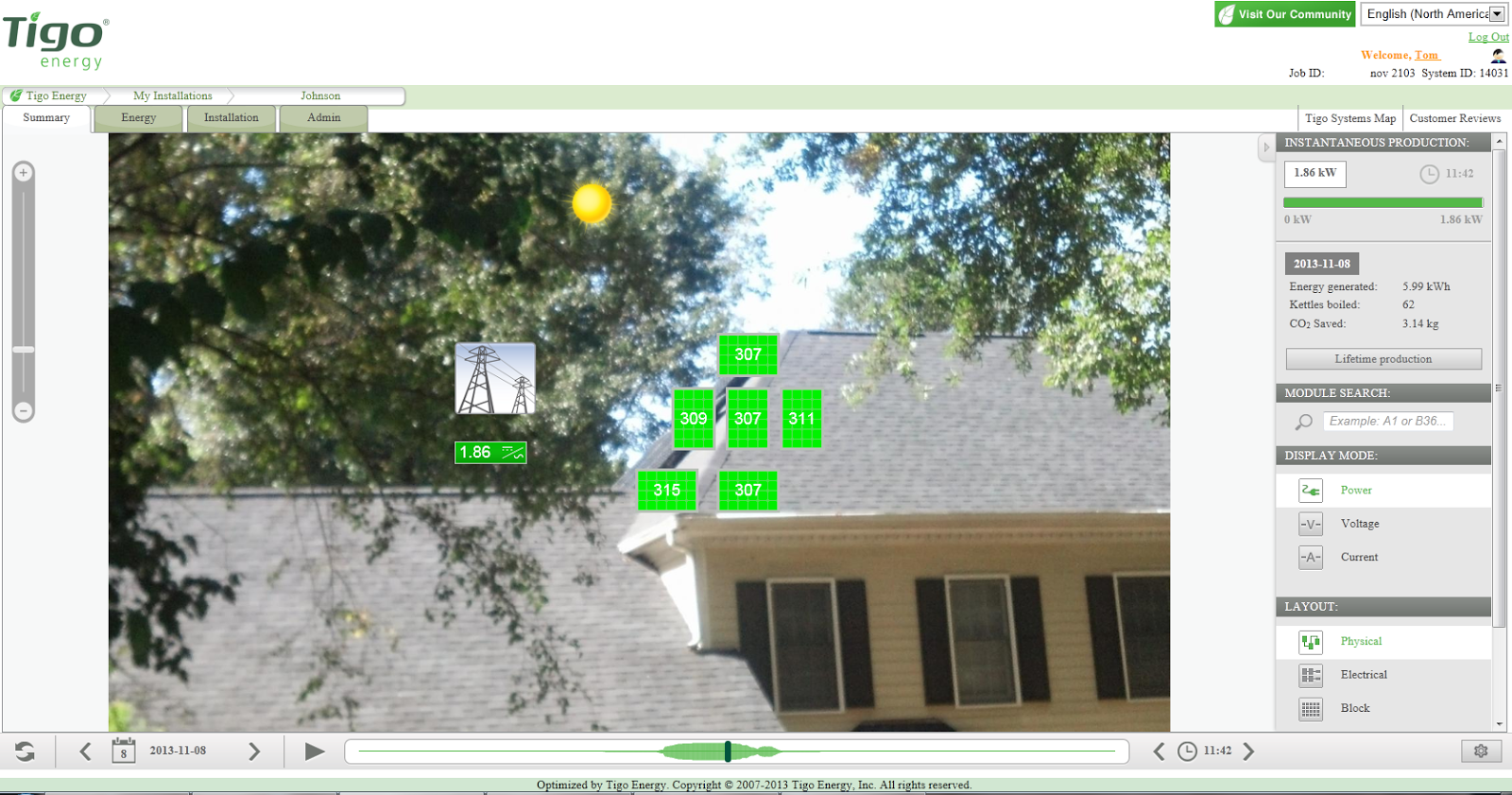
So I've finally got my Tigo system working.  It took a while for Greenspring Energy to get it running.  Part of the issue was that there was a communication issue with 2 (of 6) panels.  This communication issue for some reason meant that TIGO would not generate my login information.  That also confirmed a suspicion I had after I was watching the inverter (before Tigo and TED) only produce ~1.1 kW of power on a beautiful cloudless sunny day.  Once the communication issue was fixed (Greenspring sent over 2 technicians to diagnose and fix) the system was up and running at nearly maximum potential.  And I could finally login to Tigo.

So...why Tigo?  Well, long story short, Tigo was an alternative to microinverters such as Enphase.  It essentially allows each panel to operate individually such that if there was any shading (i.e. trees, squirrels, random cloud) then it would only affect that panel and not the entire string.  My two pics below show how the TIGO is allowing my system to have panels operating at different powers which is maximizing my power output.

Tigo online information (no shading).  System is producing 94.8% of its max potential. 

Tigo online information showing one panel shaded.  Without Tigo, I would have been producing 474W instead of 1,510W
***WARNING***
***NERDY ELECTRICAL ENGINEERING LESSON STARTING NOW***
Why is that?  Well...solar panels are wired in series.  So on one 300W panel, for instance, let's say we have 60 individual solar cells.  Each one of those cells, at optimal conditions would produce 5W such that 60 x 5W = 300W.  Well, because they are wired in series, if one cell becomes partially shaded and only produces 1W, then due to the bottle-neck, ALL the cells will only produce 1W (1W x 60 = 60W).  It doesn't matter if that cells is the first cell or the last cell in the series...then will all be bottle-necked.  And the same goes for hooking up multiple solar panels.  Bummer, huh?

The reason they do this is just the laws of electricity (I know there's a better name, but I don't have time to look it up).  So Power = Voltage x amperage.  Well for the same power, if you hook everything up in parallel, then the voltage remains constant.  Thus as you add more 'power', then the amperage must go up.  Alternatively, if you install everything in series, the amperage stays the same and thus, as power goes up, voltage goes up. 

So why not hook up panels in parallel?  Well...the more amperage you have the larger the wire you need to have.  Ever look in your breaker box?  Check out the varying size of the wires.  The wires that enter the box from your electricity meter are HUGE (200 amps, 240V) compared to those that exit and go to, say, a normal outlet (120V, 15amp).  Well...think about that for each solar panel.  Those wires cannot be 'fished' easily through walls or down conduit.  And those wires are expensive because there's a lot of copper in them.  See the following table (sorry for the headings not lining up with the rows...not sure why it copied that way).  Most likely your house is fed using either and 2/0 or 3/0 AWG cable while a normal circuit in your house is probably a 10 or a 14 AWG.

AWG
 Diameter 
inches
mm
Area
[mm2]
Resistance
Ohms / 1000 ft
Resistance
** Ohms / km
 Max Current
***
Max Frequency
for 100%
skin depth
0000 (4/0) 
0.46
11.684
107
0.049
0.16072
302
125 Hz
000 (3/0)
0.4096
10.40384
85
0.0618
0.202704
239
160 Hz
00 (2/0)
0.3648
9.26592
67.4
0.0779
0.255512
190
200 Hz
0 (1/0)
0.3249
8.25246
53.5
0.0983
0.322424
150
250 Hz
4
0.2043
5.18922
21.2
0.2485
0.81508
60
650 Hz
6
0.162
4.1148
13.3
0.3951
1.295928
37
1100 Hz
8
0.1285
3.2639
8.37
0.6282
2.060496
24
1650 Hz
10
0.1019
2.58826
5.26
0.9989
3.276392
15
2600 Hz
14
0.0641
1.62814
2.08
2.525
8.282
5.9
6700 Hz

Well a 10 AWG wire might be $1/ft at Lowes while a 2/0 AWG wire is $6.50/ft.  That's a big cost difference if you have to run a wire 100-ft to get from the roof to your breaker box.  And at 0.50" DIA try bending that 2/0 wire to get around a corner. 

Just doing the math, using the pic above where the panels were producing 1.86 kW, that's roughly 310W/panel or 52V @ 6amp.  Running in series, that's a 6amps and 310V using a 10 AWG wire.  Running in parallel that's 52V @ 36 amps which would require a 4 AWG wire.

OK...enough of the electrical engineering lesson.  Hopefully it was semi-informative even though it was basic.


Friday, November 8, 2013

Too much excitement not to share...

Screenshot from my TED5000

OK...so this week I received my extra TED5000 MTU and clamps and installed them so I can finally see what I'm producing.  It took me a bit to figure out how to get it setup appropriately though.  Once I installed the unit and checked with the software, all my readings went negative (it was 8pm at night...no sunshine). I double checked my installation and it was all appropriate.  Then I read in the forums, that I needed to removed and flip the clamps on the 'whole house' wires and that did the trick.  Once I did that then the readings were all correct.  Then, it was cloudy.  Dang!  Well, today the sun is shining brightly and I'm finally getting to see my system producing power (I knew it was, but now I can see it remotely).  Yes...I am a nerd.

From the screenshot above (11am EST) my system was producing 1.702kW while peak production is 1.962kW while I was only using about 100W, so I'm sending power to the grid, baby!  

Sometime today I should get my login information for TIGO and I'll post on that.  I'll save that saga for another post, but long story short, there was a communication error from 2 of my panels (~660W NOT producing) and Greenspring energy had to send out a technician to fix it (all panels are now producing power).  With that fixed, TIGO can communicate and I'll be able to view the real time info on each panel.  

Monday, November 4, 2013

Energized!


View of my solar panels
So my panels are up and running.  Last Thursday the folks came out and flipped the switch to start producing power.  And of course it had to be an overcast day.  And the next day it rained.  Such a bummer.  However, last weekend (and today) the sun is shining and I'm producing some power!  I checked it multiple times this weekend and I myself producing about 1.1 kW of power. Cool!

Zero Watts.  So disappointing...
The Tigo system is hooked up as well.  I can't say much about it because I still haven't gotten my login information so I can view what's going on.  And the unit at my house won't give me any information until it connects with their servers online.  What a drag!  Greenspring told me this was supposed to be done Thursday and I'd get the login information on Friday.  Well...it's Monday and still nothing.

Tigo Unit not telling me anything.  Boring...
Overall, I'm happy with the install.  That being said, I have a couple of critiques for Greenspring Energy:

1)  Be honest with the payback.  They gave me the information from PVWatts, install costs, and then estimated an ROI.  Here's what they didn't provide:
    a)  No Tax was included.  That was another ~$500 on top of the install cost.  $500 is roughly 2 years on the ROI.
    b)  Be realistic with the Duke Energy rate increases.  They used 5%/yr.  Yeah...that works for the last, oh 5 years.  But long term, it's been closer to 2%/yr.
    c)  If you conduct a solar eye, then adjust your power generation numbers! I had to ask if they did a solar eye and then ask for the results.  When I read the results, I found out that the actual estimate for power was 20% lower than what PV Watts was estimating, because it assumes an unimpeded ideal southern exposure.  I don't have that.
   d)  Solar panels degrade.  It's even one of the selling points by Sunpower...that it retains ~95% of its power after 5 years and 85% after 25 years.  That's a 0.25%/yr degradation (industry standard = 1%/yr).  Fantastic...well you gotta include those calculations in your ROI!  
   e)  Overall, my ROI was estimated at 13 years.  There's was much better.  Anybody Surprised?
   f)  Hopefully this changes, as I showed them the U.S. DOE System Adviser Model (SAM).  This model includes all the information I note above (except rate increases as user entered).

2)  I would've thought a high priced install would have looked nicer?  The panels themselves look nice\, but some of the other aspects could have been more professional looking.
  a) Below are some pictures with the install.  I'm a little disappointed that I now have a long conduit pipe running down the side of my house.  I will say that at least it's kind of hidden as it runs along the soffit. I'm probably going to have to paint it so it will blend in a little better.  Granted my breaker box isn't exactly located in the easiest place to get at. But, I will say that the wires could have been run down to the crawl space and then come out to the inverter.  I can't complain too much about it.  It definitely could have looked worse.  Judge for yourselves:
Conduit running along the side of the house to the inverter
  b) Next is the TIGO install.  Check out the wires.  Looks like of sh*tty, right?  When they were there I inquired about the wiring and they were offering to get one of those cheap-o black cord holders.  Appropriate thought, I'll give them credit.  But seriously...make it look nice.  Thus, why I went and purchased the nice wire hiding stuff.  And I may go further and have it go into the wall first, and then pop out and run along the base.  I'm not sure yet

Tigo wiring At least they put on wire ties, right?


Then there's where they came through the wall to hook up the communication to the panels via ethernet (gray wire). They ran it through the upper attic, then down to the bonus room attic knee wall (like I did when I wired the house for ethernet).  However, they just cracked my base plate and ran their wire behind mine.  Really?  You couldn't spend the $2 to buy a new plate to run it through?  And then in my bonus room attic, I spent a lot of time and effort putting up XPS insulation and sealing everything.  They just drilled a hole and ran the wire through...leaving a direct hole from the attic to my bonus room.  Couldn't even take the time to put at least piece of HVAC tape over it?!? (I did that temporarily)  Well...once I get the wire chase installed, I've already bought the new plate with the hole where I'll have the wire will run through.  And when that's done, I'll fill in the hole with the XPS with great-stuff foam.  I think I may still have ethernet materials left over....and if I do I may install an ethernet jack instead to make it look much more professional.

Wire coming through the back of the plate.

Once I get the TIGO login information, I'll post about it.  It's pretty cool stuff.

Oh...and I had to buy another adapter kit for my TED 5000.  Apparently it won't register less than zero...or I should say when it does it still reads a positive value.  So to correct my TED readings, I've had to spend $100 on a new MTU (transmitting unit) so I can measure the PV generation individually and then TED will subtract those values from my overall to give me a net (+/-) value.  I'm a little disappointed in this, but oh well.  I should have looked this up previously.

Stay tuned for more fun info!  

Tuesday, October 15, 2013

Solar Panels Installed!

the panels on my roof
Oh...its so exciting!  My solar panels were installed today.  No generation yet as i need to wait for the County inspection followed by Duke Energy's inspection and net meter hook-up.  They'll also hook up the TIGO at the same time.  So i have to wait a week or so.  Below are some pics to enjoy for now.
getting the inverter ready

Getting started on the roof


Final Inverter Installation

Final Panel Installation


My case for going solar

So as I alluded to in my last post, I've decided on installing some solar panels on my roof.

Spoiler alert!

(The panels were just installed today...but I've procrastinated on posted my internal justification.  The pics of the install will be in my next post.)

OK, so I've done a large variety of energy efficiency projects on my house including (in no particular order):

3) Lots of air sealing
7) Ecobee thermostat to optimize my HVAC operation
9) Installed all CFL and LED light bulbs
10) Got a HERs rating.  And then updated it after working on the suggestions.
11) Etc

So yeah, I've done a lot on the ole' house.  And the results have shown a substantial reduction in my home energy usage:  45.6% reduction since 2010.

After all those reductions, I finally got to a point that all the most cost effective upgrades/fixes were completed.   So what's next?  Well...generating my own power.  

I had gotten a quote in the past (here) which indicated that I could put up roughly 1.962 kW on the small area of south facing roof I have.  Here's the numbers of how it would pan out (from GreenSpring Energy):

1)  Solar panels (installation, permits, etc):  $10,791
2)  TIGO Maximizing system (to reduce issues with shading): $785
3)  Tax:  $503
4)  SubTotal:  $12,079
5)  Federal Tax Credit:  - $3,624
6)  State Tax Credit:  - $4,228
7)  Net Cost to Me:  $4,228

The system should produce roughly 2,577 kWh/year AFTER correcting for my shading issues.  That's being pretty conservative given that the SolarEye makes the calculation with leaves on the trees...when truthfully during the winter, I'll get more production than it estimates.  And the TIGO should help give it a boost (10-20%) by allowing for each panel to produce its own power rather than have shade on one panel affect the entire array.  Regardless, let's stick with the conservative estimate.  That ~2,600 kWh is worth roughly $296.  So the simple ROI is $4,228/296 = 14.3 years.  Using the DOE SAM tool (System Advisor Model) gives me 13.3 years as it factors in a lot more.  

Then there's the how much my home value will theoretical increase.  I realize that's "funny money" unless I actually sell the house...but factoring that in (20x the annual savings is what's considered the value) then that's ~$6000, so that would say the system has already paid for itself.  Again...funny money.

So another thing I thought about was "what if I got an electric car?"  It's true that the gasoline equivalent value of electricity is greater than the actual electricity equivalent.  So how would that work?  

Well...from Aug 2012 to Aug 2013, I spent $1,186 on gas for the ole' Prius.  So that could be some good savings.  Let's assume we compare my Prius to a Nissan Leaf:

Annual mileage = 12,000/yr
Prius = 48 mpg
Leaf = 34 kWh/100 miles
Gas Cost = $3.50/gallon
Electricity Cost = $0.115/kWh

Prius Annual Cost = $875 ($0.073/mile)
Leaf Annual Cost = $469 ($0.039/mile)
Savings = $406/year!

So getting an electric car itself is pretty cost effective...and I haven't even factored in the maintenance advantage (no oil changes for the Leaf).  So what happens with the addition of solar panels?  Well, for accounting purposes, let's say say that the additional driving energy for the Leaf is offset by the solar panel production.  Then we get...

Leaf Annual Electricity Consumed = 4,080 kWh
Solar Generation = 2,557 kWh
Remaining Power to be Purchased = 1,503 kWh
Revised Leaf Annual Cost = $173 ($0.0144/mile)
Revised Annual Savings = $702/year.

So I nearly triple the savings.  That takes the ROI to:  $4,228/702 = 6 years.

Wow...so I can cut the ROI in half if I take advantage of the solar + an electric car.  
Yes, I'm sure some nay-sayers will ask about financing the car.  However, I will note that I'm in the market for a car anyway (Jan 2014).  And after federal tax credits the Leaf (~$24k) is already the same price point as what I bought my Prius for ($24k).  So I'm assuming that nets-out.  Could I stick with the Prius?  Sure...but it's going on 108 kmiles right now which is creeping into that unknown maintenance.

What about range anxiety?  Yup, I'd certainly have to think about when/where I'd go and the charge I have.  But then again, my trips have gotten a lot smaller now that I kiddos have arrived.  For those work trips, I can just rent a car in lieu of driving my car.  Or I could just drive my wife's Mazda5.  The long family trips will be in the Mazda5...and that's why be bought it because we needed to haul the two of us, the twins, luggage, and (sometimes) the dog.

So yeah... I think this will work out.   And just think...if I can get my work to let me charge then the savings add up even more.  Or maybe I'll have to find a way to use those 5 charging stations at the light rail station nearby.